Forecasting world events with language models
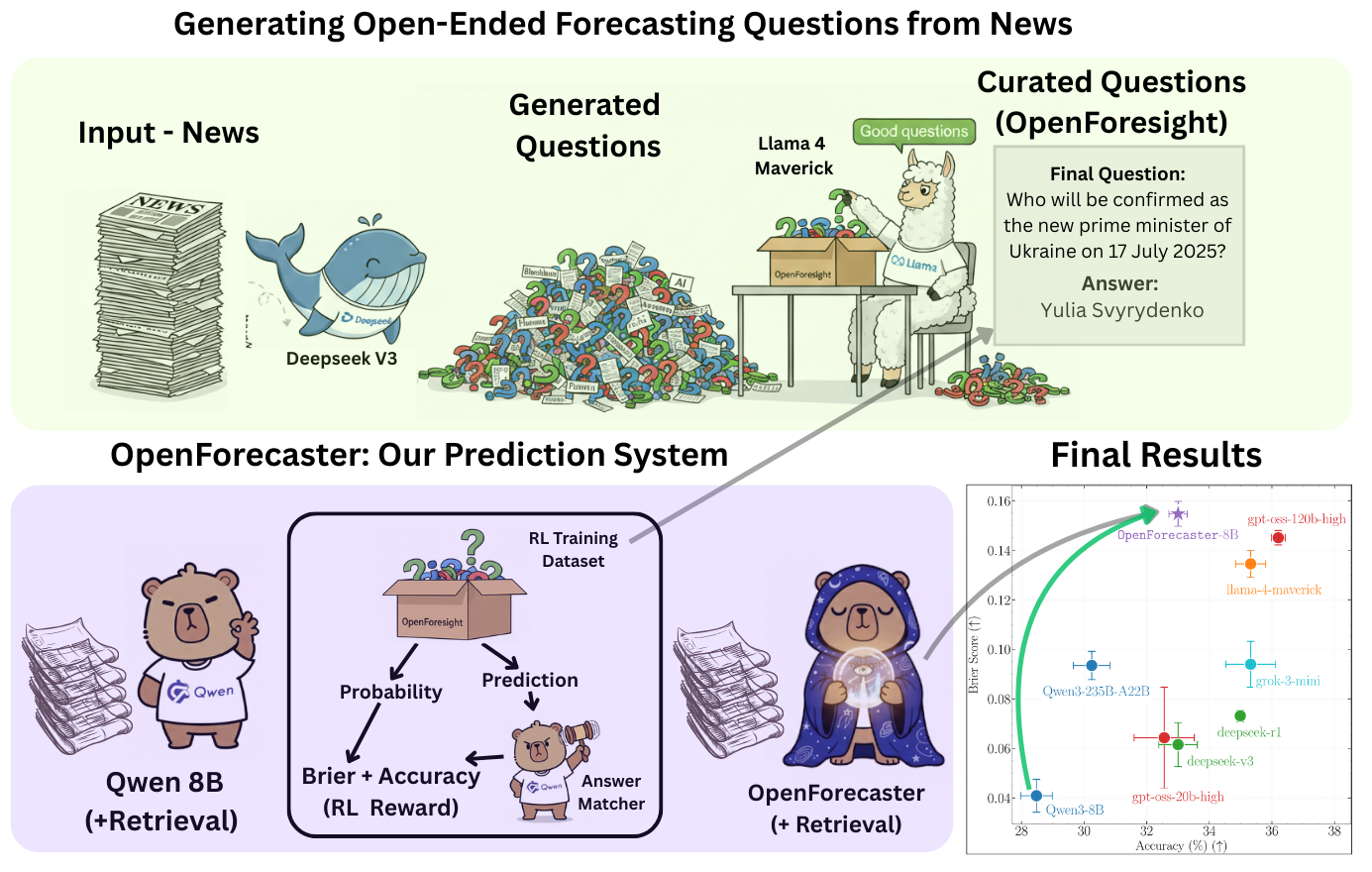
Scaling Open-Ended Reasoning to Predict the Future
Training OpenForecaster on OpenForesight improves open-ended forecasting accuracy, calibration, and consistency.
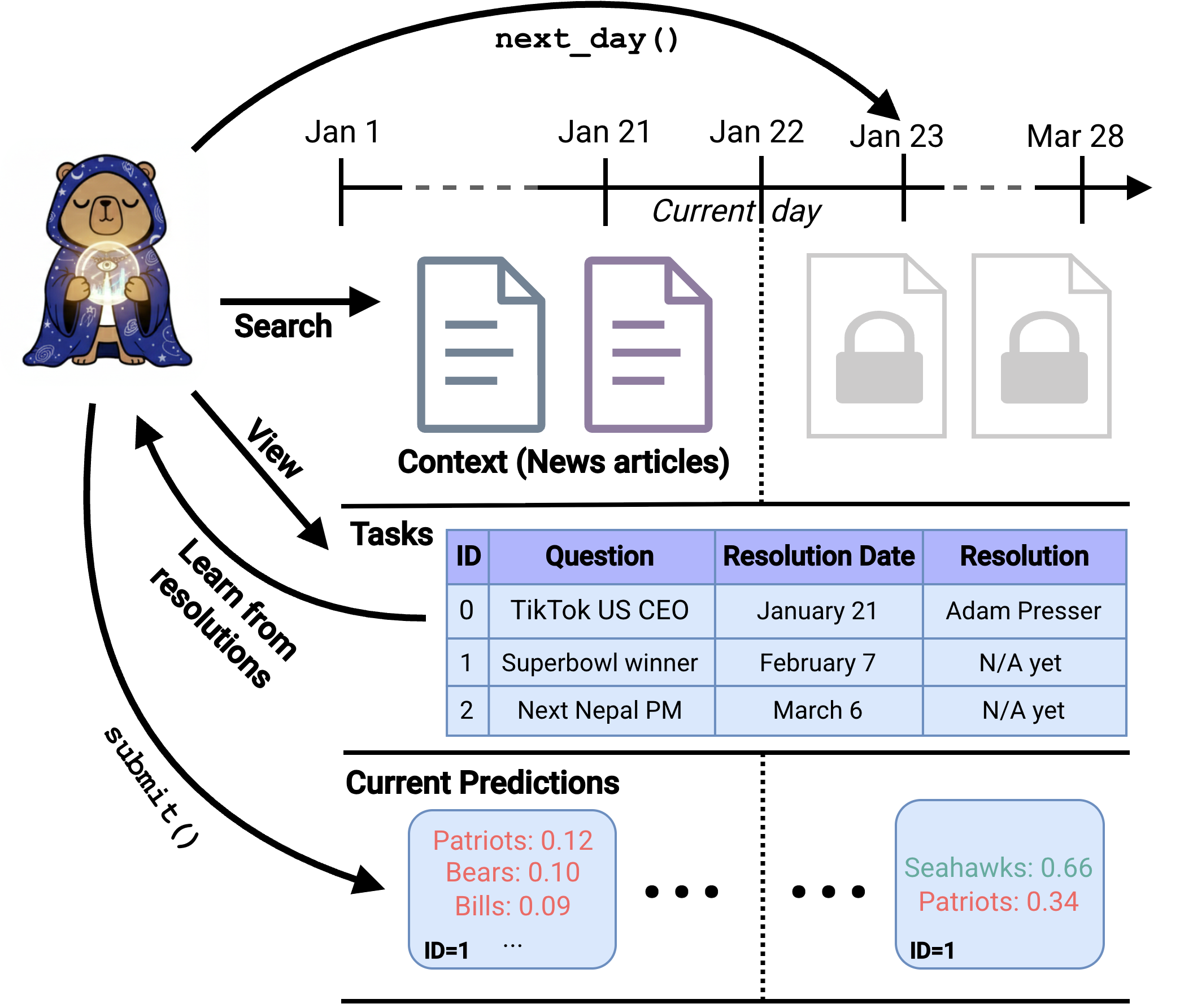
FutureSim: Replaying World Events to Evaluate Adaptive Agents
Evaluates how forecasting agents adapt their beliefs as new information arrives over real-world time.
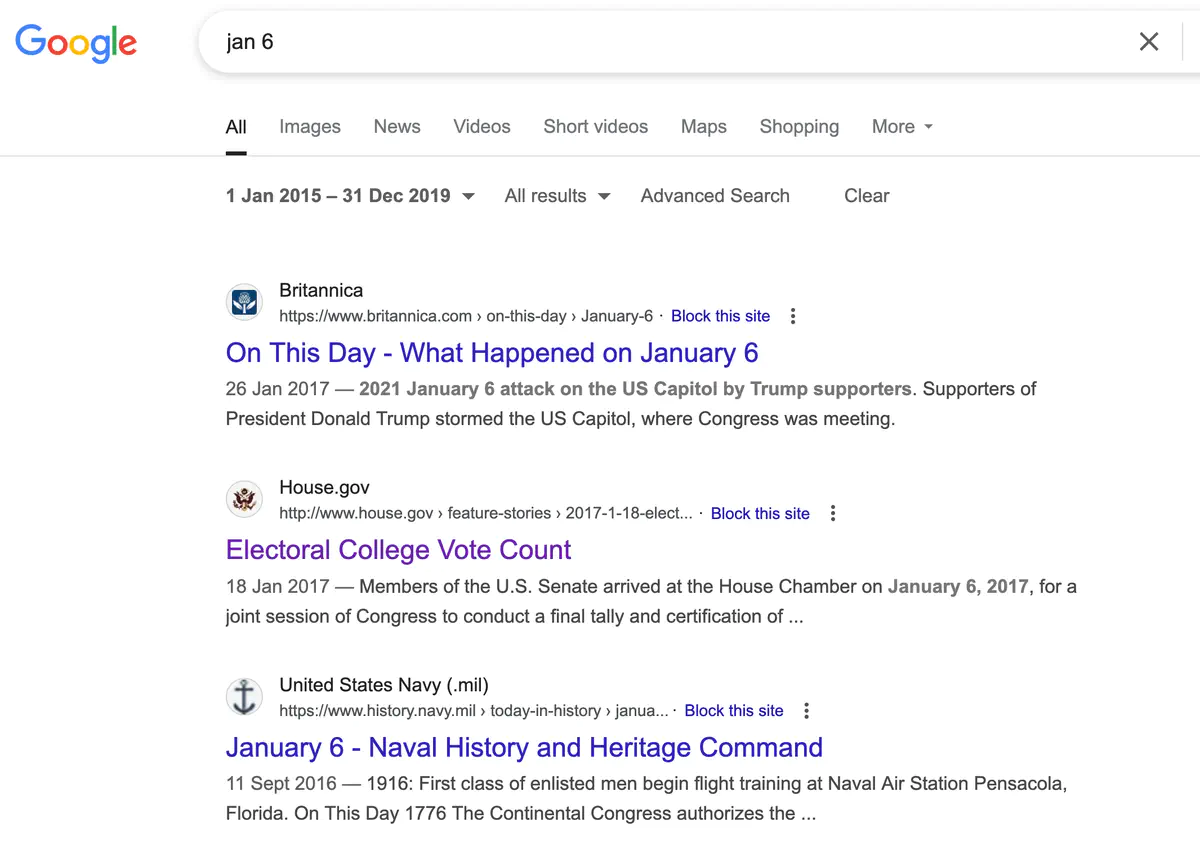
Pitfalls in Evaluating LLM Forecasters
Shows how leakage, retrieval bias, unreliable cutoffs, and benchmark incentives can break LLM forecasting evaluations.
Why we care about language model forecasting
Every day, we make decisions under uncertainty. Under the hood, such decisions often involve a forecasting problem. What gift will my friend like the most? How will this policy intervention impact the economy? Which experiment will lead to the most informative results for a research goal?
At the outset, forecasting might seem subjective. Multiple options may be backed by reasonable arguments. By design, experts get it wrong all the time--it is impossible to always be correct. There's probably a ceiling to predictability and we don't know where it is.
Crucially though, in forecasting we eventually learn the correct outcome. This provides the "verifiable" signal needed for evaluations and improvement. This is why forecasting has been a particularly successful application of ML--whether it be predicting prices, or the weather.
Yet, traditional statistical and time-series models lack the expressivity to predict the kinds of questions we deal with in our day to day, which are expressible only in natural language, also called judgemental forecasting. Language models can change this.
However, forecasting requires different capabilities than solving a fully specified math or code problem-- such as seeking new information, aggregating unreliable sources, updating beliefs coherently, and reporting appropriately hedged predictions.
One could call it building a world model of events in society.